
Inside Dr. Olga Zilberstein’s MINT PDO Training: Korean Ponytail Thread Lift & Non-Surgical Facelift Techniques
South Korea is known for its innovations in aesthetic medicine, especially when it comes to non-surgical treatments. PDO thread lifts are one of the techniques Korean physicians have continued to develop and refine, offering patients a way to lift sagging skin and improve facial contours without surgery.
Dr. Olga Zilberstein recently attended an advanced MINT PDO training to learn Korean thread-lifting techniques for the face and neck. With nearly 20 years of experience in medical aesthetics and more than 10 years of experience in thread lifting, she continues to learn from physicians around the world and explore new ways to improve the treatments she offers her patients.
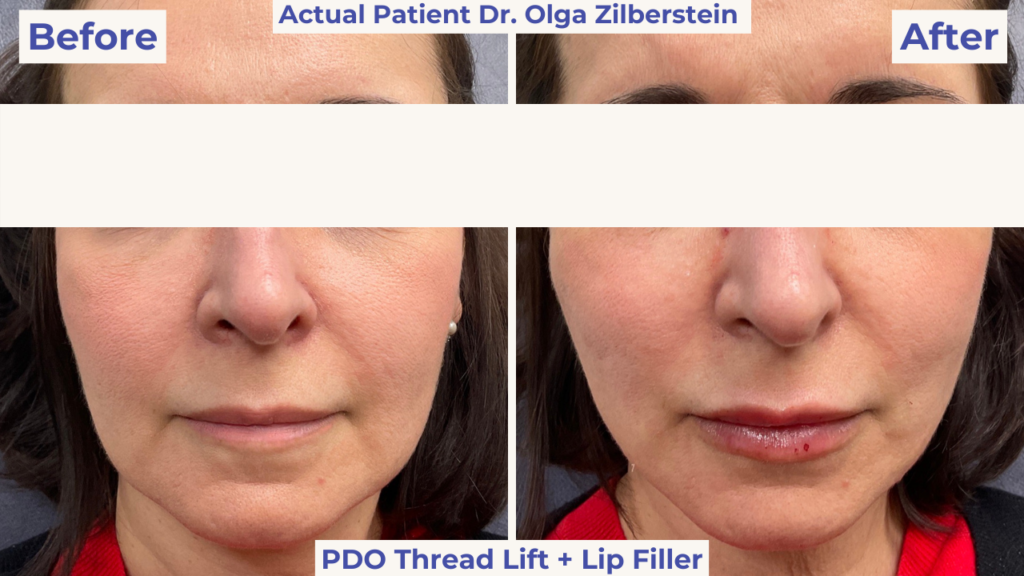
What Makes Korean Thread-Lifting Techniques Different?
Thread lifting is one of the most common treatments offered by plastic surgeons and aesthetic physicians for a natural, minimally invasive, non-surgical facelift.
During her recent training, Dr. Olga learned an approach that involves placing approximately 15–30 threads across the face and neck. The new advanced Korean deep plane ponytail technique delivers better, longer-lasting, more natural results.
Dr. Olga had the opportunity to learn from six different doctors representing six different clinics, including Dr. Jae Yoon Jung aka Dr. Benjamin aka Dr. Mielle, who has treated Kim Kardashian.
Each physician shared their approach to PDO thread lifting, giving Dr. Olga the chance to explore different techniques, learn new thread-placement methods, and see how other doctors approach facial and neck rejuvenation.
After nearly 20 years in medical aesthetics, Dr. Olga continues to invest in her education. She brings new approaches to her practice and offers her patients more options for non-surgical facial rejuvenation.
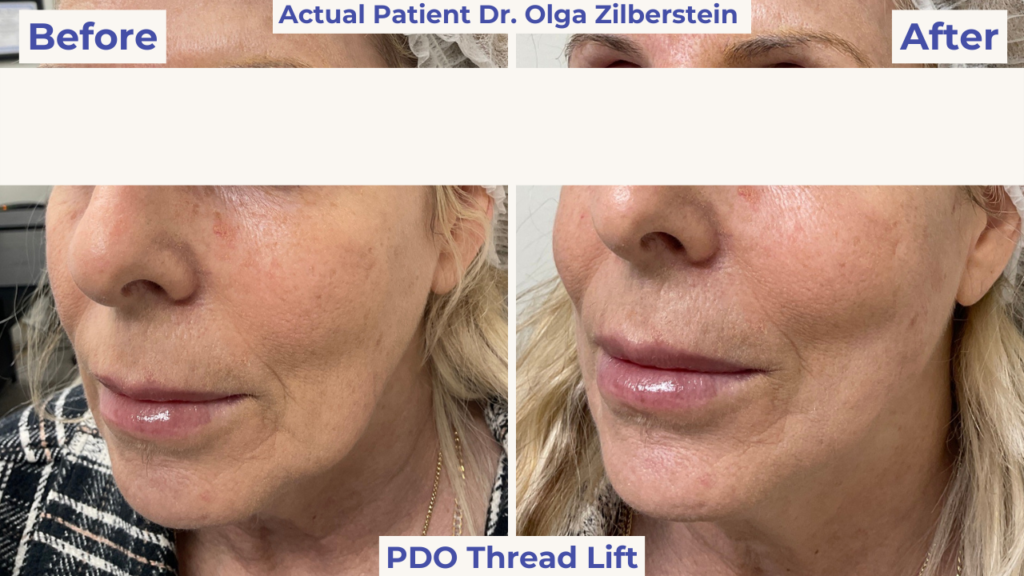
How Do PDO Thread Lifts Work?
PDO stands for polydioxanone, an absorbable suture used in medicine for more than 40 years.
During treatment, the physician inserts threads beneath the skin to lift and support sagging tissue. MINT PDO threads have tiny molded barbs that anchor into the tissue, allowing the physician to reposition it and create a lifting effect.
Unlike a traditional facelift, a PDO thread lift doesn’t require surgery and involves minimal or no downtime. It can be a good option for patients noticing early jowling, sagging cheeks, or loss of jawline definition who aren’t ready for surgery.
The Results Continue to Develop After Treatment
One of the benefits of PDO threads is that they don’t just provide an initial lift. They also stimulate collagen production as they gradually dissolve.
Collagen is what helps keep our skin firm and supported, but we produce less of it as we age. By encouraging new collagen formation, PDO threads can help improve skin firmness and elasticity in the months following treatment.
So while patients may notice a lifting effect immediately, they can continue to see improvements as the threads settle and new collagen develops.
MINT PDO results last one to two years, depending on the individual patient and treatment.
Frequently Asked Questions About Thread Lifts
What are the different types of threads used for a thread lift?
There are different types of threads used in aesthetic medicine, including PDO (polydioxanone) and PCL (polycaprolactone) threads. These materials differ in how they are made, how long they remain in the tissue, and how they may be used in treatment.
There are also mono threads, which are very small, smooth threads commonly used to support collagen production and improve skin firmness and quality.
Twist threads, also known as spiral mono threads, are designed to stimulate collagen production and improve thin, crepey skin. They’re commonly used in areas such as the neck and under the eyes to help improve skin quality and firmness.
What are mono threads used for?
Mono threads can be used in areas where the goal is to improve skin quality rather than create a major lifting effect.
At Dr. Olga’s, mono threads may be incorporated into treatments for areas such as the jawline, under the chin, and areas of thin or crepey skin.
They may also be used on areas of the body where looseness can develop, including above the knees, around the elbows, and above the belly button.
Can PDO threads be combined with filler, Botox, or other treatments?
Yes. PDO threads can be combined with other aesthetic treatments to create a more complete facial rejuvenation result.
Treatments such as filler, Botox, and biostimulators like Radiesse and Sculptra can address concerns like volume loss, tissue elasticity, facial balance, and wrinkles that threads alone may not fully correct.
Dr. Olga may also recommend treatments such as RF microneedling or Tixel before a thread lift to improve skin quality and texture before lifting the tissue.
Who is a good candidate for a PDO thread lift?
A good candidate for a PDO thread lift is typically someone with mild to moderate sagging.
Skin thickness also matters. Patients with slightly thicker skin and enough tissue support may be better candidates for thread lifting, while very thin skin may make the threads more visible and may not provide enough support for the desired lifting effect.
Can I get a thread lift if I plan on getting a facelift in the future?
Yes. Having a PDO thread lift does not prevent you from having a surgical facelift later. PDO threads dissolve within 6–9 months.
It is better to wait at least one year after your last thread lift before having facelift surgery.
A facelift could be performed earlier; the threads would just need to be removed during the surgery.
How often can you get a thread lift?
A thread lift can be repeated as the results gradually fade. PDO threads dissolve within 6-9 months, although results last up to 18 months. It is usually safe to perform a thread lift every 12-18 months.
Why are threads placed in different directions?
The direction in which threads are placed is called a vector. Different vectors are used depending on the area being treated, the direction of sagging, and what the treatment is trying to improve.
For example, different vectors may be used to address jowls or sagging cheeks and midface.
The placement used to lift the cheeks may be different from the placement used to define the jawline or improve jowling. It is used to refine and improve the jawline and reduce submental fullness.
Does the direction of thread placement affect the lift?
Yes. The direction and placement of threads can affect how effectively the tissue is supported and repositioned.
The physician considers where sagging is present, the direction in which the tissue needs to move, and the most effective placement for that specific area.
This is one of the techniques Dr. Olga focused on during her recent Korean MINT PDO training, including learning different vectors for different indications and more efficient placement patterns for lifting.
What type of anesthesia is used for a PDO thread lift?
PDO thread lifting is performed with local anesthesia to help keep the patient comfortable during treatment.
Dr. Olga injects lidocaine into the treatment area so patients do not feel the thread placement. Tylenol may also be given for additional comfort. Overall, the treatment is designed to be very comfortable for the patient.
We can combine it with Nitric Oxide for better pain control and anxiety.
Threads for Non-Surgical Nose Job (Nasal Barb Threads)
We use special nasal barb threads to elevate and refine the dorsum of the nose, as well as elevate the tip of the nose.
Dr. Olga specializes in non-surgical nose jobs and combines fillers, nasal barb threads, and Botox to perform a liquid nose job.
The procedure is performed under local anesthesia, is relatively painless, takes approximately 30 minutes, and has almost no downtime.
PDO thread lift aftercare. What should you avoid?
Patients are generally advised to be gentle with the treated area while the threads begin to settle. Aftercare may include temporarily avoiding:
- Strenuous exercise and heavy lifting within 2 weeks
- Facial massage or excessive pressure on the treated area for 2 weeks
- Radiofrequency and other energy-based devices for around 6 months
- Excessive facial movement for 2 weeks
- Dental appointments for one month
- Sleeping directly on the treated area for 1 week
Patients should also try to sleep with an elevated head for the first two weeks following treatment.
How long does it take to recover from a PDO thread lift?
A PDO thread lift involves much less downtime than a surgical facelift. Mild swelling, bruising, soreness, or tightness can occur during the first several days.
Many patients return to normal daily activities the same day. Recovery varies depending on the area treated and the patient’s individual healing response.
Interested in PDO thread lifting? Schedule a consultation with Dr. Olga Zilberstein at her Brooklyn or Long Island practice to learn whether the treatment is right for you.


